
ON-GOING PROJECTS
HABs: MODELLING OF HARMFUL ALGAE BLOSSOMS
Abstract:
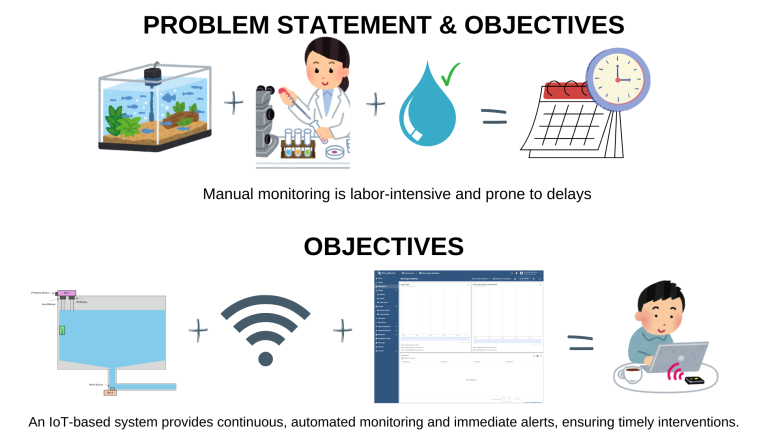
The aquaculture industry is highly dependent on maintaining optimal water quality to ensure the health and productivity of aquatic organisms. Traditional methods of monitoring water quality are often labour-intensive, time-consuming, and more inclined to delays in detecting harmful changes. This project addresses these challenges by developing a real-time, automated monitoring system using IoT technology and ThingsBoard for data visualization. The primary motivation for this project is to enhance the efficiency and reliability of water quality monitoring in aquaculture settings. Key water parameters such as temperature, dissolved oxygen, and turbidity levels are crucial for the well-being of aquatic life. Deviations from optimal conditions can lead to severe consequences, including disease outbreaks and high mortality rates. Thus, there is a significant need for a system that can provide continuous, accurate monitoring and timely alerts to aquaculture operators. The methodology involves the integration of various water quality sensors with microcontrollers such as the ESP8266 and ESP32 that perform edge computation to process data locally. This reduces the dependency on cloud computation and ensures faster response times. Data from the sensor nodes are transmitted via Wi-Fi communication modules to ThingsBoard, an open-source IoT platform. ThingsBoard serves as the centralized hub for data visualization, providing real-time dashboards, historical trends, and alert notifications. By implementing this IoT-based solution, the project aims to deliver a scalable and cost-effective water quality monitoring system. The use of ThingsBoard for dashboard visualization enhances the user experience by providing intuitive and actionable insights. This system not only improves the operational efficiency of aquaculture farms but also contributes to the sustainability and productivity of the aquaculture industry