
ON-GOING PROJECTS
RiOT: REHABILITATION USING INTERNET OF THINGS
Abstract:
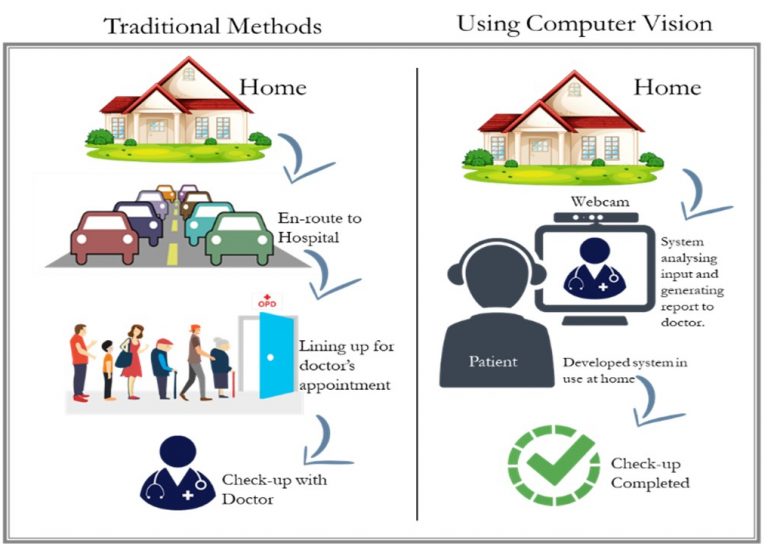
Computer vision is advancing swiftly and giving valuable answers in our daily lives, notably in health; its use is desirable. Rehabilitation patients must routinely visit their doctors to check on the progress of their physical, which involves hand stretches. This has become troublesome and time-consuming as most time is spent travelling from home to rehabilitation centers. We can use computer vision to follow this progress virtually instead, and this project captures how much the hand is stretched and translates it to volume in percentage. This technique will eliminate the need for patients to travel to hospitals for rehabilitation, allowing them to do it at home. The device uses a webcam coupled to a computer and a Python software to overcome the trip challenge. The system leverages Multimedia Development Life Cycle (MDLC) as its proposed technique, first recognizing a patient's hand via the webcam, then picking up the thumb and index finger points to aid the stretch distance, which is subsequently translated to volume. The patient merely needs to plug in a webcam, run the program, and stretch their palm 30cms away from the camera for optimal accuracy. The system tested well, picking up hand points and displaying volume dependent on hand stretch in real time. The innovative solution solves the travel barrier to hospitals for rehabilitation, allowing patients to relax without anxiety.
COBOT: SMART ATTENDANCE SYSTEM BASED ON AUTONOMOUS CAR
Abstract:

Current attendance methods are simple, however it is prone to manipulation and time-consuming for educators and students. For example, manual attendance system and QR code scanning allow students to register attendance for their friends since these methods lack unique identification. Increasing security by calling students names one by one is more secure but disrupts the learning process by consuming a lot of time. This study aims to minimize manipulation in attendance and ensure a better learning experience. An autonomous car (CObot) equipped with a facial recognition system powered by a Raspberry Pi microcontroller is developed to move automatically around the classroom, avoiding obstacles. This approach saves time in the attendance process by eliminating the need for students or educators to move around. Using facial recognition ensures that only registered individuals can mark their attendance, resulting in a more secure system. For better bookkeeping, the autonomous robot utilizes the Internet of Things (IoT) to transfer attendance data to Google Sheets, easing the educator's workload by saving space and making records easier to trace. The use of 3D printing allows for customizable car structures. Compared to other microcontrollers like the ESP32-S3, the Raspberry Pi 5 is chosen for its superior processing power and data transfer speeds, ensuring a smoother process for data analysis and transfer. This CObot aims to enhance the classroom environment by benefiting both students and educators. Although seamless attendance processes may seem like a small contribution, CObot is significant in ensuring a better learning environment. In an experiment with 60 participants, the ESP32-S3 achieved a 90% accuracy rate in facial recognition, whereas the Raspberry Pi 5 achieved a 99% accuracy rate. Consequently, the Raspberry Pi 5 not only processes information faster but also provides a more secure and accurate facial recognition system
HABs: MODELLING OF HARMFUL ALGAE BLOOMS
Abstract:

Current attendance methods are simple, however it is prone to manipulation and time-consuming for educators and students. For example, manual attendance system and QR code scanning allow students to register attendance for their friends since these methods lack unique identification. Increasing security by calling students names one by one is more secure but disrupts the learning process by consuming a lot of time. This study aims to minimize manipulation in attendance and ensure a better learning experience. An autonomous car (CObot) equipped with a facial recognition system powered by a Raspberry Pi microcontroller is developed to move automatically around the classroom, avoiding obstacles. This approach saves time in the attendance process by eliminating the need for students or educators to move around. Using facial recognition ensures that only registered individuals can mark their attendance, resulting in a more secure system. For better bookkeeping, the autonomous robot utilizes the Internet of Things (IoT) to transfer attendance data to Google Sheets, easing the educator's workload by saving space and making records easier to trace. The use of 3D printing allows for customizable car structures. Compared to other microcontrollers like the ESP32-S3, the Raspberry Pi 5 is chosen for its superior processing power and data transfer speeds, ensuring a smoother process for data analysis and transfer. This CObot aims to enhance the classroom environment by benefiting both students and educators. Although seamless attendance processes may seem like a small contribution, CObot is significant in ensuring a better learning environment. In an experiment with 60 participants, the ESP32-S3 achieved a 90% accuracy rate in facial recognition, whereas the Raspberry Pi 5 achieved a 99% accuracy rate. Consequently, the Raspberry Pi 5 not only processes information faster but also provides a more secure and accurate facial recognition system
EARLY FLOOD DETECTION AND MONITORING SYSTEM
Abstract:

Current attendance methods are simple, however it is prone to manipulation and time-consuming for educators and students. For example, manual attendance system and QR code scanning allow students to register attendance for their friends since these methods lack unique identification. Increasing security by calling students names one by one is more secure but disrupts the learning process by consuming a lot of time. This study aims to minimize manipulation in attendance and ensure a better learning experience. An autonomous car (CObot) equipped with a facial recognition system powered by a Raspberry Pi microcontroller is developed to move automatically around the classroom, avoiding obstacles. This approach saves time in the attendance process by eliminating the need for students or educators to move around. Using facial recognition ensures that only registered individuals can mark their attendance, resulting in a more secure system. For better bookkeeping, the autonomous robot utilizes the Internet of Things (IoT) to transfer attendance data to Google Sheets, easing the educator's workload by saving space and making records easier to trace. The use of 3D printing allows for customizable car structures. Compared to other microcontrollers like the ESP32-S3, the Raspberry Pi 5 is chosen for its superior processing power and data transfer speeds, ensuring a smoother process for data analysis and transfer. This CObot aims to enhance the classroom environment by benefiting both students and educators. Although seamless attendance processes may seem like a small contribution, CObot is significant in ensuring a better learning environment. In an experiment with 60 participants, the ESP32-S3 achieved a 90% accuracy rate in facial recognition, whereas the Raspberry Pi 5 achieved a 99% accuracy rate. Consequently, the Raspberry Pi 5 not only processes information faster but also provides a more secure and accurate facial recognition system
MODELLING OF SMART WATERING SYSTEM
Abstract:

Current attendance methods are simple, however it is prone to manipulation and time-consuming for educators and students. For example, manual attendance system and QR code scanning allow students to register attendance for their friends since these methods lack unique identification. Increasing security by calling students names one by one is more secure but disrupts the learning process by consuming a lot of time. This study aims to minimize manipulation in attendance and ensure a better learning experience. An autonomous car (CObot) equipped with a facial recognition system powered by a Raspberry Pi microcontroller is developed to move automatically around the classroom, avoiding obstacles. This approach saves time in the attendance process by eliminating the need for students or educators to move around. Using facial recognition ensures that only registered individuals can mark their attendance, resulting in a more secure system. For better bookkeeping, the autonomous robot utilizes the Internet of Things (IoT) to transfer attendance data to Google Sheets, easing the educator's workload by saving space and making records easier to trace. The use of 3D printing allows for customizable car structures. Compared to other microcontrollers like the ESP32-S3, the Raspberry Pi 5 is chosen for its superior processing power and data transfer speeds, ensuring a smoother process for data analysis and transfer. This CObot aims to enhance the classroom environment by benefiting both students and educators. Although seamless attendance processes may seem like a small contribution, CObot is significant in ensuring a better learning environment. In an experiment with 60 participants, the ESP32-S3 achieved a 90% accuracy rate in facial recognition, whereas the Raspberry Pi 5 achieved a 99% accuracy rate. Consequently, the Raspberry Pi 5 not only processes information faster but also provides a more secure and accurate facial recognition system